Your heating bill just arrived, and the number makes you wince. You haven’t changed your habits, temperatures outside seem normal for the season, yet your costs keep climbing. Before you blame your furnace or accept these bills as inevitable, check your thermostat. A thermostat problem could be silently draining your wallet every single day.
Let’s take a look at how it does so.
How Does A Faulty Thermostat Impact Your Bills?
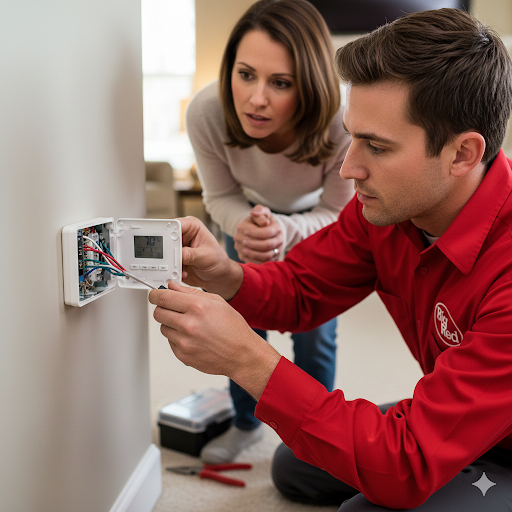
Your thermostat acts as the command center for your entire HVAC system. It tells your furnace when to turn on, how long to run, and when to shut off. A properly functioning thermostat maintains your desired temperature efficiently, running your heating system only as much as necessary.
A broken thermostat or one with calibration issues changes everything. It might tell your furnace to run longer than needed, heat your home to higher temperatures than you’ve set, or cycle on and off inefficiently. Each of these scenarios burns through energy and your money.
Think of it this way: if your thermostat thinks your home is 65°F when it’s actually 70°F, it keeps running your heat trying to reach a temperature you’ve already achieved. That’s wasted energy that translates directly to higher bills. Over a month or an entire winter season, this thermostat problem can cost you hundreds of dollars in excess heating costs.
Common Thermostat Problems That Increase Heating Costs
Not all thermostat issues are obvious. Some quietly waste energy for months before you realize something’s wrong. Let’s look at the most common culprits.
Incorrect Temperature Readings
If your thermostat is miscalibrated or poorly placed, it may read your home as 65°F when the living space is actually closer to 70°F. As a result, your heating system keeps running unnecessarily, wasting energy and driving up your heating bills. Over an entire winter season, this kind of faulty thermostat issue can cost homeowners hundreds of dollars in excess heating costs
Poor thermostat placement contributes to this issue, too. Thermostats installed near drafty windows, in direct sunlight, near heat sources like lamps or appliances, or in rarely used rooms get false temperature readings that trigger excessive heating cycles.
Short Cycling Issues
Short cycling happens when your heating system turns on and off rapidly in short bursts rather than running in longer, efficient cycles. A thermostat problem often causes this inefficient pattern. The constant starting and stopping uses more energy than steady operation while putting extra wear on your heating system.
You might hear your furnace kick on, run for just a minute or two, then shut off, only to repeat the cycle shortly. This broken thermostat behavior can double your heating costs compared to normal operation.
Stuck or Unresponsive Controls
Sometimes thermostats simply stop responding to your adjustments. You might set it to 68°F, but it continues heating to 72°F. Or you lower the temperature before bed, but the setting doesn’t register. These issues force your system to overheat your home, wasting significant energy.
Mechanical thermostats with physical switches can stick in one position. Digital models might freeze or stop accepting input. Either way, this thermostat problem means you’ve lost control over your heating costs.
Programming Failures
Programmable thermostats save money by automatically adjusting temperatures based on your schedule. But when programming fails, whether the thermostat loses its settings, the internal clock drifts, or scheduled changes stop executing, you lose these savings.
Your thermostat might maintain daytime temperatures all night when it should lower them, or keep heating an empty house when everyone’s at work. These programming glitches quietly inflate your heating bills day after day.
Signs Your Thermostat Problem Is Costing You Money
How do you know if a faulty thermostat is behind your high bills? Watch for these warning signs that indicate you need thermostat service.
- Your heating bill suddenly jumps without explanation. You notice the room feeling warmer or cooler than the temperature displayed on your thermostat.
- Your furnace runs constantly or cycles on and off more frequently than usual. The thermostat display is blank, dim, or shows error messages.
- Your programmed schedule stops working, requiring constant manual adjustments.
- You might also notice that adjusting the temperature setting doesn’t change your home’s actual temperature, or different rooms have wildly varying temperatures despite one thermostat controlling the whole house.
Any of these symptoms suggests a thermostat problem that’s likely increasing your heating costs right now.
Why Modern Thermostats Make A Difference
If you’re still using an old mechanical thermostat with a dial or sliding lever, upgrading to a modern thermostat can dramatically reduce your heating bills. Here are a few reasons why:
- Older models often develop calibration drift over time, becoming increasingly inaccurate.
- A modern thermostat offers precision that mechanical models can’t match. Digital thermostats maintain temperature within one degree of your setting, while old mechanical ones might vary by three to five degrees.
- Programmable and smart thermostats take efficiency even further. They automatically adjust temperatures based on your schedule or even learn your patterns and preferences.
Many modern thermostat models connect to your smartphone, allowing you to adjust settings remotely and catch heating issues before they spike your bills.
- Smart thermostats also provide energy reports showing when your system runs and how much energy you use. This visibility helps you identify patterns and problems, including faulty thermostat issues, before they cost you serious money.
Simple Checks Before Calling For Heating Services
Before scheduling professional thermostat service, try these quick troubleshooting steps. You might solve the problem yourself:
- First, replace the batteries in battery-powered thermostats. Dead or weak batteries cause numerous issues that seem like major problems but resolve instantly with fresh batteries.
- Clean the thermostat by removing the cover and gently blowing out dust, as dust buildup can interfere with mechanical components and sensors.
- Check your circuit breaker to ensure power reaches your thermostat and HVAC system. A tripped breaker mimics a broken thermostat perfectly.
- Verify all settings, particularly on programmable models, where settings sometimes change accidentally. Make sure your system switch is set to “heat” rather than “cool” or “off.” It sounds silly, but it happens.
If these simple fixes don’t resolve your thermostat problem, it’s time to call professionals for heating services.
Can A Faulty Thermostat Cause High Electricity Bills?
Delaying repairs or replacement of a broken thermostat can cost you money every day. A thermostat that’s off by just three degrees can increase heating costs by causing your system to run longer than necessary. Over a winter season, that wasted energy can add up to hundreds of dollars in unnecessary expenses.
A faulty thermostat can also force your heating system to work harder than necessary, accelerating wear on expensive components. Skipping a relatively small thermostat service today may save a few hundred dollars upfront, but prolonged strain on your furnace can increase the risk of major repairs or even premature replacement, costing thousands down the line.
Compare that to the cost of addressing the issue now. Basic thermostat service typically costs $80-150. A new modern thermostat ranges from $50 for a simple programmable model to $250 for a high-end smart thermostat, plus installation. Most homeowners recoup these costs through energy savings within one to two years.
Also Read: How To Reduce Heating Costs During The Coldest Winter Months
Conclusion
A thermostat problem might seem minor, but its impact on your heating bills is anything but small. Pay attention to the warning signs: unexplained bill increases, temperature inconsistencies, frequent cycling, or unresponsive controls.
To address these issues quickly, you may schedule a heating repair service with us. Our certified technicians are fully equipped to handle repairs for all heating brands, whether it’s a furnace or a heat pump. We also offer thorough maintenance and heating system repairs, proactively identifying any issues before they become expensive problems.
Also Read: Home Energy Efficiency That Actually Works